Feb 21, 2026 / 3 min read / AI Engineering
Gemini 3.1 Pro for Engineers: What Changed
Gemini 3.1 Pro for Engineers: What Changed
Gemini 3.1 Pro launched on February 19, 2026 with broad preview availability and a strong benchmark narrative. For engineering teams, the practical question is not "is it new," but "what changed in deployment risk, evaluation confidence, and operating cost."
The short answer: rollout scope and capability claims moved fast; pricing and evaluation caveats still require disciplined interpretation.
At a glance
- Google launched Gemini 3.1 Pro in preview across developer, enterprise, and consumer surfaces on February 19, 2026.
- The model card reports stronger scores on several coding and reasoning benchmarks, but cross-model comparisons still require method caveats.
- API pricing for
gemini-3.1-pro-previewfollows familiar 3 Pro-style bands, so adoption decisions should focus more on quality and workflow fit than on headline token deltas.
What Google actually announced
On February 19, 2026, Google announced Gemini 3.1 Pro as an upgraded model in the Gemini 3 family and described it as a stronger baseline for complex tasks.
Google also described phased preview access across surfaces:
- developers: Gemini API in Google AI Studio, Gemini CLI, Google Antigravity, and Android Studio
- enterprise: Vertex AI and Gemini Enterprise
- consumers: Gemini app and NotebookLM
The Gemini API changelog on February 19, 2026 confirms both:
Gemini 3.1 Pro Previewgemini-3.1-pro-preview-customtools
That second endpoint is operationally important for teams building tool-heavy agents because it signals explicit productization of custom-tool workflows, not just a model refresh.
Capability and benchmark signals (and limits)
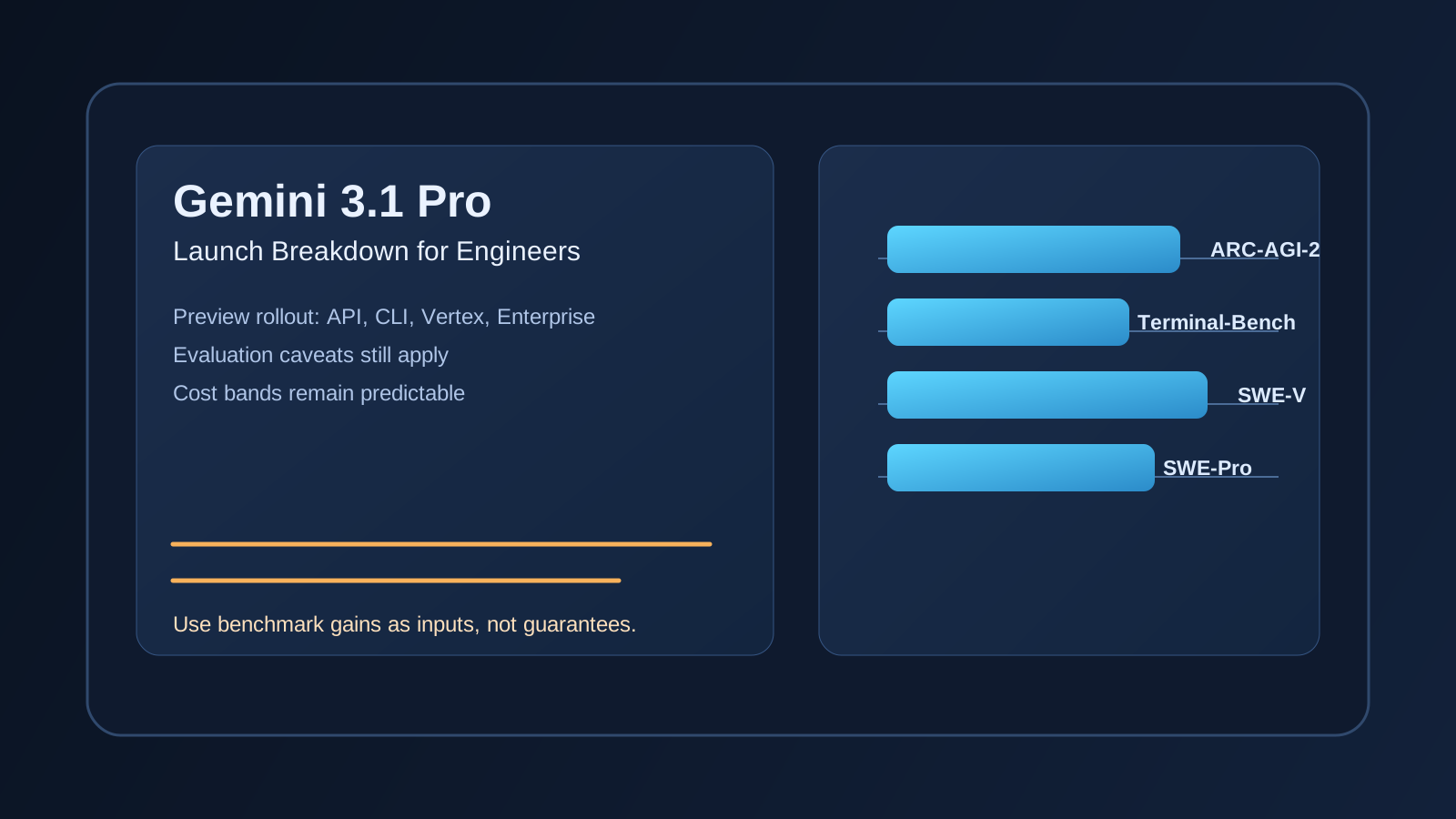
Google's announcement highlights ARC-AGI-2 at 77.1% for Gemini 3.1 Pro. The DeepMind model card provides a wider table, including:
- HLE (no-tools): 44.4%
- ARC-AGI-2: 77.1%
- Terminal-Bench 2.0: 68.5%
- SWE-Bench Verified: 80.6%
- SWE-Bench Pro Public: 54.2%
Those numbers are useful directional signals, but they are not plug-and-play procurement truth. The model card and the linked Gemini 3.1 Pro evaluation-method document explicitly note methodology constraints, including benchmark setup specifics and that many non-Gemini competitor scores are provider self-reported unless otherwise stated.
For engineering decisions, that means you should treat benchmark deltas as hypothesis inputs, then confirm with your own task-based evaluations.
API and pricing implications for real teams
As of the pricing page state retrieved on February 21, 2026, gemini-3.1-pro-preview is listed with these paid Standard rates:
- input: $2.00 per 1M tokens for prompts
<= 200k; $4.00 for prompts> 200k - output (including thinking tokens): $12.00 per 1M tokens for prompts
<= 200k; $18.00 for prompts> 200k
Batch rates are half of Standard for both input and output bands ($1/$2 input and $6/$9 output).
In practice, this keeps the cost conversation familiar for teams already routing work through Gemini 3 Pro style economics. Simon Willison's February 19, 2026 notes also call out similar pricing while pointing to launch-day demand/latency pressure, which is a reminder to validate reliability under your own load.
Where Gemini 3.1 Pro fits in a production workflow
A practical rollout pattern for engineering orgs:
-
Start with bounded pilot lanes. Use one or two high-value tasks (for example: incident triage summaries or cross-file refactors) instead of broad default routing.
-
Separate benchmark confidence from shipping confidence. Keep benchmark tracking, but gate production rollout on task-level acceptance tests, failure-rate tracking, and regression review.
-
Track price with prompt-size buckets. Because pricing changes at the 200k prompt threshold, monitor your prompt-length distribution before assuming stable unit economics.
-
Snapshot external rankings, do not anchor to them. Arena-style leaderboards are useful for directional checks, but rank positions are dynamic and should not replace internal evaluation.
Bottom line
Gemini 3.1 Pro is a meaningful launch for engineering teams because preview availability is broad and the benchmark package is strong. But rollout quality still depends on local evaluation discipline.
- Treat official benchmarks as inputs, not guarantees.
- Validate on your own workflows before widening routing.
- Use prompt-size and reliability telemetry to decide where 3.1 Pro is actually better for your stack.
Sources
- Google announcement: Gemini 3.1 Pro (Feb 19, 2026)
- Gemini API changelog (Feb 19, 2026 entry)
- Gemini Developer API pricing
- Google Cloud blog: Introducing Gemini 3.1 Pro on Google Cloud
- DeepMind model card: Gemini 3.1 Pro
- DeepMind eval methodology: Gemini 3.1 Pro
- Arena leaderboard snapshot
- Simon Willison notes (Feb 19, 2026 archive)
Newsletter
Follow new posts through RSS or via email updates.